
Stop undercharging! Learn the exact cake pricing formula used by professional bakeries to calculate ingredients, labor, and overhead for maximum profit.
📑 Table of Contents
- How to Price Custom Cakes: The Complete Guide to Profitability
- 🚀 Short on Time?
- The Real Cost of a Custom Cake
- The Golden Cake Pricing Formula
- 1. Ingredient Costs (COGS)
- 2. Labor Costs (Your Hourly Wage)
- 3. Overhead Expenses
- 4. Profit Margin
- Pricing Table: Real-World Examples
- Case Study: The "Expensive" Customer
- Common Pricing Mistakes to Avoid
- How to Increase Your Profits Without Raising Prices
- Frequently Asked Questions
- Conclusion
How to Price Custom Cakes: The Complete Guide to Profitability
One of the most common questions I get from home bakers is: "How do I know what to charge for my cakes?" Most beginners start by looking at what the local grocery store charges, or worse, they ask a Facebook group for advice. Both of these are recipes for burnout. To build a sustainable, profitable bakery business, you need a logical, data-driven cake pricing formula.
In this guide, I’m going to break down the exact formula used by six-figure bakeries to ensure every cake they sell makes a profit. We’ll cover ingredients, labor, overhead, and that all-important profit margin.
🚀 Short on Time?
If you're tired of manual calculations, our Bakery Pro SaaS automates this entire process. Track ingredients, calculate labor, and generate professional quotes in seconds.
Upgrade to Bakery ProThe Real Cost of a Custom Cake
Before we look at the formula, you have to realize that you aren't just selling flour and sugar. You are selling a specialized service. When a customer orders a custom cake, they are paying for:
- Professional-grade ingredients
- Hours of specialized labor (designing, baking, decorating)
- Business overhead (electricity, website, insurance)
- Your unique artistic skill
If you only charge for the ingredients, you aren't running a business—you're running a charity.
The Golden Cake Pricing Formula
The industry standard formula for pricing any baked good is:
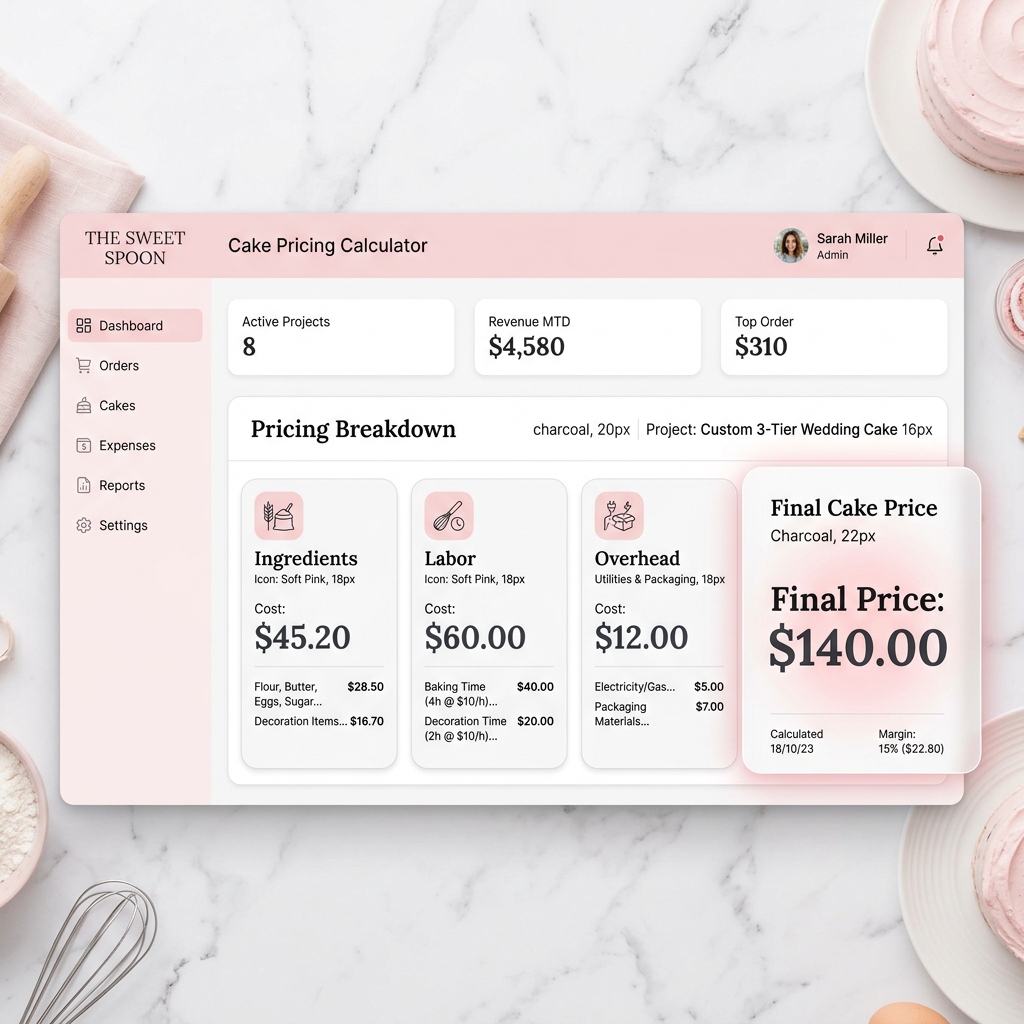
(Ingredients + Labor + Overheads) + Profit Margin = Final Price
Let's break down each component of the cake pricing formula so you can apply it to your own business today.
1. Ingredient Costs (COGS)
This is your "Cost of Goods Sold." You must calculate the cost of every single item that goes into the cake. This includes:
- Flour, sugar, eggs, butter
- Specialty fillings (ganache, fruit, curds)
- Fondant, food coloring, edible glitter
- Structural elements (cake boards, dowels, boxes)
- Packaging (ribbon, business cards, stickers)
Example: If a 5lb bag of flour costs $4.00 and you use 1lb in a recipe, that’s $0.80 of flour. You need to do this for every ingredient. Most bakers find it helpful to use a Cake Pricing Calculator to keep track of bulk prices vs. recipe portions.
2. Labor Costs (Your Hourly Wage)
This is where 90% of home bakers fail. You must pay yourself. Decide on an hourly rate (e.g., $25/hour) and track your time from start to finish. This includes:
- Consultation and design time (30 mins)
- Grocery shopping (30 mins - prorated)
- Baking and cooling (1 hour)
- Frosting and decorating (3-5 hours)
- Cleaning up (30 mins)
If a cake takes you 6 hours total and your rate is $25/hour, your labor cost is $150. This is before you've even accounted for ingredients!
3. Overhead Expenses
Overhead are the costs required to keep your business running that aren't directly tied to one specific cake. Common overheads include:
- Utilities (electricity for the oven, water for cleaning)
- Rent (if you use a commercial kitchen)
- Insurance, licenses, and permits
- Marketing (website hosting, social media ads)
- Equipment wear and tear
A simple way to calculate this is to take your total monthly overhead costs and divide them by the number of cakes you expect to sell. Alternatively, many home bakers add a flat 10-15% of their combined ingredient and labor costs to cover overhead.
4. Profit Margin
Wait, isn't labor my profit? No. Your labor is your salary. Profit is what the business keeps to reinvest. Profit is used for:
- Buying new equipment (like a new stand mixer)
- Professional development (classes, certifications)
- Savings for slow months
- Expansion
A healthy profit margin for custom cakes is usually 20-30% on top of your total costs (Ingredients + Labor + Overhead).
Pricing Table: Real-World Examples
To help you visualize the cake pricing formula, here is a comparison of two common orders:
| Cost Component | Standard 8" Birthday Cake | 3-Tier Custom Wedding Cake |
|---|---|---|
| Ingredients/Packaging | $25.00 | $120.00 |
| Labor (Hours x $25) | $75.00 (3 hrs) | $375.00 (15 hrs) |
| Overhead (10%) | $10.00 | $49.50 |
| Subtotal | $110.00 | $544.50 |
| Profit Margin (25%) | $27.50 | $136.12 |
| Recommended Price | $137.50 | $680.62 |
Case Study: The "Expensive" Customer
I once had a baker tell me they lost a sale because the customer said $150 was "too much for a birthday cake." After checking her numbers, we realized the cake actually cost her $120 to make in labor and ingredients alone. By losing that sale, she saved herself 4 hours of work that would have only netted her a "profit" of $30 (less than $8/hour).
The Lesson: Your price isn't too high; they just aren't your target customer. When you use a solid cake pricing formula, you can stand by your price with confidence because you know exactly why it is what it is.
Common Pricing Mistakes to Avoid
- Pricing "By the Slice" Only: This works for simple cakes, but for custom designs, the labor per slice varies wildly. Always use a base price + decorating fees.
- Forgetting "Hidden" Ingredients: Many bakers forget the costs of boxes, cake boards, and cleaning supplies. These add up!
- Underestimating Decorating Time: That "simple" fondant bow might take you 45 minutes to get perfect. Track your time using a tool like our Bakery Order Planner.
- Competing with Supermarkets: You are an artisan, not a factory. Supermarkets use preservatives and machine-line production. You use fresh ingredients and hand-crafted designs. Never lower your price to compete with Costco.
How to Increase Your Profits Without Raising Prices
If your prices are already at the market ceiling, focus on efficiency. This is where professional tools come in:
- Bulk Ordering: Lower your COGS by buying in bulk.
- Recipe Scaling: Use a Recipe Scaler to ensure you never waste ingredients.
- Inventory Tracking: Know what you have so you don't overbuy.
Frequently Asked Questions
Should I charge for delivery?
Yes. Calculate the round-trip time and mileage. If it takes you 1 hour to deliver and set up, that is labor that must be paid.
What if my hourly rate makes the cake "too expensive"?
If your labor makes the cake price higher than the market can bear, you either need to improve your speed or target higher-income customers (like the wedding market).
Should I offer discounts for friends?
Be careful. If you must, discount your profit margin, but never your labor or ingredient costs. You shouldn't have to pay out of pocket for your friends to have a cake.
Conclusion
Mastering the cake pricing formula is the single most important step in turning your hobby into a sustainable business. By accounting for your ingredients, your labor, your overhead, and your profit, you ensure that your business can grow and thrive for years to come.
Ready to automate your pricing? Check out Bakery Pro and stop guessing your numbers today.
Turn Your Passion into a Bakery Pro Business
Join 500+ home bakers who use our software to automate pricing, manage orders, and grow their profits.
Save Your Calculations?
Get the Bakery Business OS to save recipes, track inventory, and manage orders in one place.
Reclaim Your Time →Buy Bakery Profit Calculator Bundle