
From crusty artisan breads to flaky pie crusts and chewy cookies, explore the different types of dough recipes and learn how to master them all.
📑 Table of Contents
- Mastering the Foundation: Different Types of Dough Recipes
- 1. The Anatomy of Dough: Key Ingredients
- 2. Bread Doughs: The Magic of Fermentation
- 3. Pastry Doughs: The Art of Tenderness and Flakiness
- 4. Flatbreads and Pizza Dough
- 5. Cookie Doughs
- 6. Pasta and Noodle Doughs
- 7. Essential Dough Terminology
- Troubleshooting Common Dough Issues
- Conclusion
Mastering the Foundation: Different Types of Dough Recipes
Dough is the beautiful, versatile canvas of the baking world. Consisting of little more than flour, a liquid, and sometimes a leavening agent or fat, these simple ingredients can transform into an endless variety of textures, flavors, and forms. Whether you are a novice taking your first steps into the kitchen or an experienced home baker looking to refine your craft, understanding the different types of dough recipes is crucial to expanding your culinary repertoire.
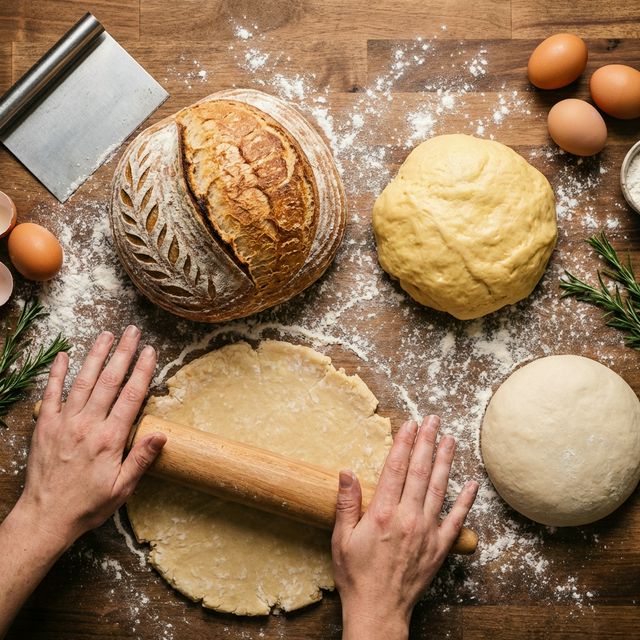
At its core, all baking is chemistry. The way proteins in flour interact with water to form gluten, the way yeast ferments sugars to create gas and rise, and the way fat coats flour particles to create tenderness—these are the fundamental principles that govern every dough from the crustiest artisan loaf to the flakiest croissant. In this comprehensive guide, we will break down the vast world of dough into its distinct categories, exploring what defines them, how they work, and the classic recipes that utilize them.
1. The Anatomy of Dough: Key Ingredients
Before diving into the specific types of dough, it is essential to understand the building blocks. Every dough is a delicate balance of four main components:
- Flour: The structural backbone. The protein content of flour determines how much gluten can form. Bread flour (high protein) creates a chewy, strong network, while cake or pastry flour (low protein) yields a tender crumb.
- Liquid: Usually water or milk, liquid hydrates the flour, activating the proteins to form gluten and waking up the yeast.
- Leavening Agents: These make the dough rise. Biological leaveners (like commercial yeast or wild sourdough starter) produce carbon dioxide over time. Chemical leaveners (like baking powder and baking soda) react instantly with heat and acid. Steam can also act as a powerful mechanical leavener.
- Fat: Butter, oil, lard, or egg yolks. Fat coats the flour proteins, preventing them from forming long, tough gluten strands. This is known as "shortening" the dough, which is why doughs with high fat are often referred to as "short."
2. Bread Doughs: The Magic of Fermentation
Bread doughs rely on yeast to ferment sugars and create gas, which becomes trapped in the gluten network, making the dough rise. They are broadly divided into two distinct categories:
Lean Doughs
Lean doughs are the purists of the baking world. Made with only the bare essentials—flour, water, salt, and yeast—they contain little to no added fat or sugar. Because there is no fat to inhibit gluten development, lean doughs build incredibly strong structures. These bake into deeply savory breads with a hard, crackling crust and an open, chewy crumb.
- French Baguettes: The quintessential lean dough. Crisp on the outside, light and airy on the inside.
- Ciabatta: An Italian slipper bread made with a very high hydration (water-to-flour ratio), resulting in large, irregular holes in the crumb.
- Sourdough Boules: These utilize a wild yeast starter instead of commercial yeast. The long, slow fermentation process breaks down the flour, resulting in a complex, tangy flavor profile and improved digestibility.
- Bagels and Pretzels: These are stiff, lean doughs that undergo a unique boiling step before baking, which creates their signature chewy exterior and glossy finish.
For precise formulation when baking lean doughs, always use a Baker's Percentage Calculator to scale your recipes accurately based on the weight of your flour.
Enriched Doughs
If lean doughs are the everyday staples, enriched doughs are the luxurious weekend treats. These doughs contain generous amounts of added fats, sugars, or dairy (like butter, eggs, and whole milk). The added fat tenderizes the gluten strands, resulting in a soft, pillowy, tight-knit crumb and a tender crust that browns beautifully due to the extra sugars.
- Brioche: A classic French dough that boasts an incredibly high ratio of butter and eggs. It is rich, golden, and melts in the mouth.
- Challah: A traditional Jewish bread enriched with eggs and oil, famous for its intricate braided appearance and subtly sweet flavor.
- Sweet Rolls: The base for cinnamon rolls, sticky buns, and babka. This dough is soft, supple, and designed to hold rich fillings without becoming tough.
3. Pastry Doughs: The Art of Tenderness and Flakiness
Pastry doughs generally do not rely on yeast. Instead, they heavily rely on the specific fat-to-flour ratio and meticulous temperature control to create their signature textures, ranging from crumbly and tender to light and shatteringly crisp.
Shortcrust and Tart Doughs
These doughs are defined by their "short" (tender) texture, achieved by rubbing cold fat into flour before adding a minimal amount of liquid.
- Pâte Brisée (Pie Dough): The standard for savory quiches, chicken pot pies, and classic sweet fruit pies. Cold butter is cut into flour until it resembles coarse meal, leaving visible shards of butter. When baked, the water in the butter evaporates into steam, creating distinct flaky layers.
- Pâte Sucrée (Sweet Tart Dough): Richer, sturdier, and sweeter than pie dough, containing egg yolks and sugar. It is Creamed together like cookie dough, resulting in a crisp, crumbly shell perfect for holding delicate pastry creams and fresh fruit.
- Pâte Sablée: Even richer and more delicate than Pâte Sucrée. "Sablée" translates to "sandy," which perfectly describes its melt-in-the-mouth, shortbread-like texture.
Laminated Doughs
Lamination is a highly technical process where a block of solid butter (the beurrage) is wrapped inside a lean dough, and then repeatedly rolled out and folded upon itself. This creates hundreds of alternating microscopic layers of dough and butter.
- Puff Pastry (Pâte Feuilletée): The ultimate laminated dough, containing no yeast. In the intense heat of the oven, the moisture in the butter turns to steam, forcing the thin layers of dough apart, causing it to puff up dramatically.
- Croissant and Danish Dough: These are laminated doughs that also contain yeast. The combination of steam from the butter layers and carbon dioxide from the yeast creates a pastry that is simultaneously incredibly flaky, airy, and softly bread-like in the center.
Pâte à Choux (Choux Pastry)
A completely unique anomaly in the pastry world. Choux is cooked on the stovetop before baking. Butter, water, milk, and flour are boiled together into a paste, which gelatinizes the starches. Eggs are then beaten in. The resulting dough has a very high moisture content. In the oven, the moisture turns to steam so rapidly that it causes the dough to balloon up, creating hollow shells that are inherently crispy on the outside and custardy on the inside. This is the foundation for eclairs, cream puffs, and profiteroles. Learn more about working with these foundations in our Basic Pastry Doughs Guide.
4. Flatbreads and Pizza Dough
Pizza dough bridges the gap between lean bread dough and flatbreads. While it is technically a lean dough, its specific application deserves its own category.
A classic Neapolitan pizza dough typically requires a finely milled, highly extensible flour (like '00' flour) to develop a strong but flexible gluten network. This allows the dough to be stretched extremely thin by hand without tearing, while retaining a satisfying chew in the crust (the cornicione).
A truly exceptional pizza dough undergoes a slow, cold fermentation in the refrigerator for 24 to 72 hours. This retards the yeast activity, allowing enzymes to break down starches into complex sugars, resulting in a deeply flavorful, highly digestible crust with beautiful blistering when baked at high temperatures. Want to try mastering this technique? Check out our Ultimate Homemade Pizza Dough Recipe.
Other notable flatbread doughs include Middle Eastern Pita (which puffs to create a pocket), Indian Naan (enriched with yogurt and baked in a tandoor), and Italian Focaccia (a highly hydrated, olive oil-rich dough that is baked in a pan).
5. Cookie Doughs
While often categorized loosely as "batter" depending on the hydration, cookie dough is fundamentally a dough characterized by a very high fat and sugar content, and very minimal liquid. The type of cookie entirely dictates the dough's consistency and handling:
- Drop Cookies: A softer, stickier dough that is scooped and dropped directly onto a baking sheet. As the butter melts in the oven, they spread into familiar shapes like chocolate chip, oatmeal raisin, and snickerdoodles.
- Cut-Out Cookies: A firmer, stiffer dough that must be chilled thoroughly, rolled flat, and stamped with cookie cutters. The low moisture and chilled fat prevent the cookies from spreading, allowing them to hold intricate shapes (e.g., sugar cookies and gingerbread men).
- Icebox (Refrigerator) Cookies: A soft dough that is formed into a rigid log, wrapped tightly, and chilled until completely solid. The baker then slices uniform rounds straight from the cold log before baking.
- Pressed and Molded Cookies: Doughs forced through a cookie press (like spritz cookies) or pressed into intricate wooden molds (like speculoos).
6. Pasta and Noodle Doughs
Not all dough goes into the oven. Pasta doughs are entirely unleavened and are meant to be cooked by boiling in salted water.
- Egg Pasta Dough: Traditional Northern Italian pasta consisting simply of finely milled "00" flour and fresh whole eggs. The eggs provide both the liquid for hydration and the fat for a silky, rich, golden noodle. This dough requires intense kneading to develop enough gluten to hold its shape when rolled paper-thin.
- Semolina Pasta Dough: Used predominantly in Southern Italy for dried pasta shapes. It combines coarse semolina flour (from durum wheat) with warm water. This creates a highly structured, firm dough perfect for extrusion.
- Asian Dumpling and Noodle Doughs: Often utilizing specialized techniques, such as using hot boiling water to denature the proteins in the flour, resulting in a dough that is incredibly elastic, soft, and pliable—perfect for wrapping delicate fillings without snapping back.
7. Essential Dough Terminology
As you explore these different recipes, you will frequently encounter specific baking terminology related to dough management:
- Hydration: The ratio of water to flour in a recipe, expressed as a percentage. A 75% hydration dough uses 750g of water for every 1000g of flour. Higher hydration yields a more open crumb but is stickier to handle.
- Autolyse: A resting period where only flour and water are mixed and left to sit before adding yeast or salt. This fully hydrates the starches and kickstarts gluten development passively.
- Bulk Fermentation: The primary, first rise of the entire batch of dough before it is divided or shaped.
- Proofing: The final rise of the dough after it has been shaped into its final form, just before baking.
Troubleshooting Common Dough Issues
Even the most experienced bakers encounter dough difficulties. Here are quick fixes for common problems:
- Dough is too tough or shrinks back when rolling: The gluten is overworked or tense. Solution: Cover the dough and let it rest at room temperature for 15-20 minutes to allow the gluten network to relax before trying again.
- Dough is too sticky to handle: It may be over-hydrated or not kneaded enough to build structure. Solution: Resist the urge to add massive amounts of raw flour. Instead, use the "slap and fold" technique, use a bench scraper, or try lightly wetting or oiling your hands to prevent sticking.
- Bread dough didn't rise: The yeast might be dead, the liquid was too hot (killing the yeast), or the environment is too cold. Solution: Always check the expiration date on yeast, ensure water is lukewarm (not hot), and find a warm spot (like an off oven with the light on) for proofing.
Conclusion
The mastery of dough is an incredible journey. Every type of dough—from a rustic, crusty sourdough to a delicate, flaky croissant—requires its own specific handling, temperature control, and respect for the ingredients. By understanding the fundamental differences between these doughs, you demystify the baking process. You unlock the ability not just to follow recipes, but to understand them, modify them, and ultimately bake almost anything imaginable with confidence and joy in your own kitchen.
Save Your Calculations?
Get the Bakery Business OS to save recipes, track inventory, and manage orders in one place.
Reclaim Your Time →